


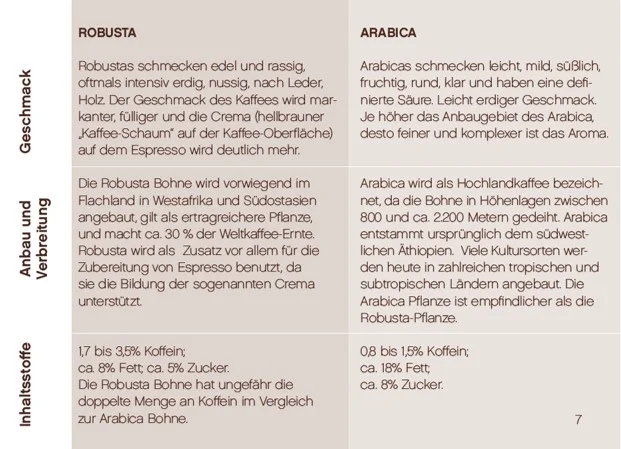
There are many varieties of coffee beans. But only three are economically viable to cultivate: Arabica, Robusta and Maragogype (Elephant beans are about twice as large as the other two varieties). In recent years, quality-conscious coffee experts and Institutions prefer Arabica coffee . This is partly because Arabica beans – also Mountain coffee called – produce a fine and mild coffee. Therefore, a lot of effort was put into the development of Arabica beans. There are more reasons for this:

-
Historically, the Robusta bean (scientific name: Coffea canephora) has fallen into disrepute. This happened as follows: From the 1960s onwards, the market – that is, we humans – increasingly demanded cheaper coffee The roasting industry has responded to this demand with quantity and speed:
a) Quantity: More and more low-quality raw materials were used: large quantities of low-quality Robusta beans were mixed with the green coffee —> this is how the prices could be achieved
b) Fast processing: A hot air process was developed that quickly prepares coffee ( industrial roasting ) or, to be more specific, “burns” it. This was how this need could be met. -
As a result, quality-conscious producers around the world no longer saw any incentive to invest in Robusta growing areas . This area was left to the more exploitative farms. Robusta cultivation therefore remained at the old state of the art. The goal was purely economic, rapid yields. No development, no consideration of ecological or taste effects. Because it was assumed, and in some cases still is, that people cannot taste the difference anyway.
-
With the aim of producing cheap coffee in large quantities (how else could a pack in the supermarket cost from EUR 3,-?!?), unfortunately large coffee producers still produce these cheap, non-developed Robusta beans Arabica beans as “filler material” mixed in. Economically clever: you need less of the more expensive bean. Because the palate of a typical consumer only tastes such a mixture when the Robusta content is very high. And that way the price can be kept nice and low. But to a certain extent it is a Misleading packaging.
-
And – last but not least – a reason that always speaks for Robusta – even today: Robusta is – this is easy to remember with a mnemonic – more robust. The plant is not nearly as susceptible as the Arabica bushes and therefore coffee farms often prefer to cultivate them.
Thus, the worldwide trend in the 1960s to the early 1990s was towards cheaper Robusta coffee.
Exceptions prove the rule, of course : in Italy and Austria there have always been and still are high-quality Robusta-Arabica blends. You just have to know where to find them and ask for them. Because the composition of both types of beans is of course perfect for all those who Love “chocolaty roasts” :
A good blend ensures the typical coffee taste that we love so much in Germany:
slightly roasted (dark roasted) with intense, fine notes, full body on the palate with a long finish and lots of crema. What more could you want?
The above-mentioned global demand for cheap coffee ushered in a counter-trend among real coffee lovers: the Arabica era . The Arabica plant was clearly preferred. Of course, this is also due to the taste: Arabica is the finer coffee. ARABICA has more chromosomes and contains less chlorogenic acid than Robusta. This makes this coffee taste beautifully complex and much more digestible than Robusta. The Arabica plant also has a very special feature: the mountain coffee is the only coffee plant of its kind that can pollinate itself.
For all the reasons mentioned here, coffee lovers worldwide rightly demand Roasts made from pure 100% Arabica beans . Some even take it to the extreme: you are not even allowed to utter the word “Robusta” in their presence: you are immediately exposed as a “coffee proletarian”.
Of course, the trend towards lighter roast the Robusta bean has been pushed somewhat into the background:
Arabica beans are simply better suited for the cinnamon-light coffee roast, which is first made from Trieste and later – even brighter – from Scandinavia and the USA or. Australia has migrated to us. The bean's fine character makes the lighter roasts appear wonderfully harmonious. Robusta beans, on the other hand, require a longer roasting time so that the typical aromas can develop better. This longer roasting time naturally also draws out the fruitiness and increases the bitterness.
ROBUSTA AND ITS IMPORTANCE IN CLIMATE CHANGECurrently, two factors are playing a role that are giving the Robusta variety a boost:
-
In recent years, many roasters – especially the micro-roasters who use DirectTrade are in close contact with their coffee farmers – recognized that Robusta beans have very good taste qualities if you give it the same attention as the Arabica bean. If Robusta is grown with love and professional care, it will produce a wonderful coffee result in the cup!
-
And the second factor that plays a role and is now on everyone’s lips: the Climate change.
As mentioned above, the Robusta plant is robust. It is much more resistant than the Arabica bushes. Strong sunlight, temperature fluctuations or insects have little effect on Robusta bushes and cherries. It therefore provides an essential prerequisite for future Heat waves and dry periods: Robusta coffee farmers therefore have an increased chance of continuing to grow coffee in the future. And even of increasing their income. Provided, of course, that the dear Bees still have time to do their work. Because, as mentioned above, only the Arabica plant can pollinate itself – the Robusta coffee cherries need the busy little creatures that fly from flower to flower. And we know that bees love caffeine – see the blog post “ Bees fly on caffeine! ”
In return, the Arabica plant will certainly become an even more expensive “high-end product”. This is because the rarity will determine the demand and thus the price in connoisseur circles.
Coffee farmers say they are already feeling the effects of the climate. It will certainly be a while before we can taste these effects here in Austria. Apart from raising awareness, in the meantime I recommend you to...
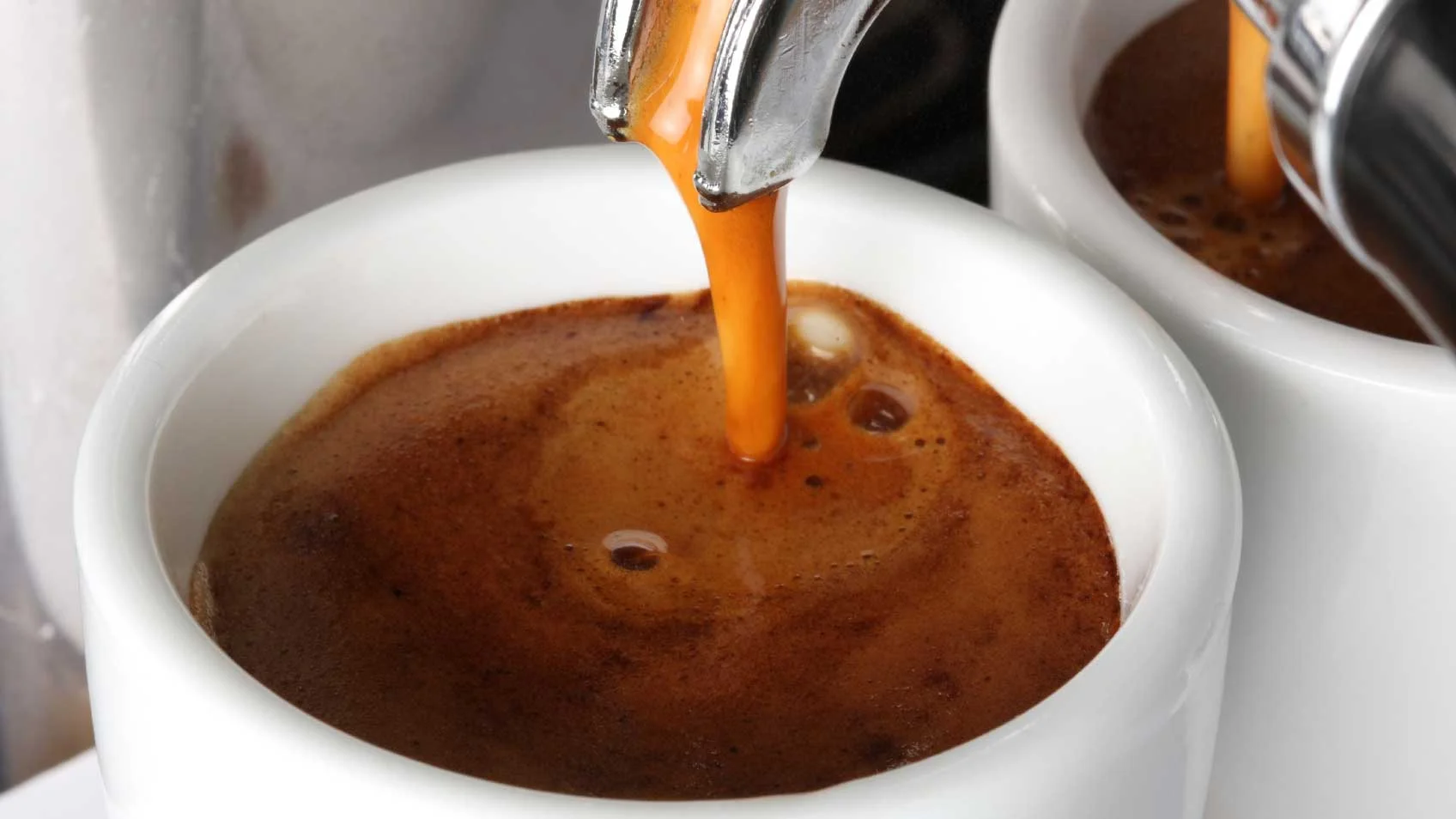
You don't have to go for "Abbruzzi" or "Campania" (regions in Italy) and drink coffee with 100% Robusta. That's a bit too "medicinal" for our taste.
And beware: Robusta contains around twice as much caffeine as Arabica . So less is more. But I think hardly anyone can resist a nice cup of espresso, typically Italian style . It simply contains everything a coffee lover's heart desires:
Aromas of chocolate, nuts, nougat combined with a light fruitiness and delicate bitter notes and of course the associated “break feeling”. Pure luxury. Coffee is Dolce Vita in liquid form!
I hope I have made your mouth water and you are now heading straight to the kitchen or to the nearest café for a nice cup of black gold!
Your coffee lover Patrick Schönberger, your “coffee pad”
beautiful contribution from the great writer:
P.Schönberger
1000 thanks for your coffee love
your Mecki